
The Floor Beneath the Price
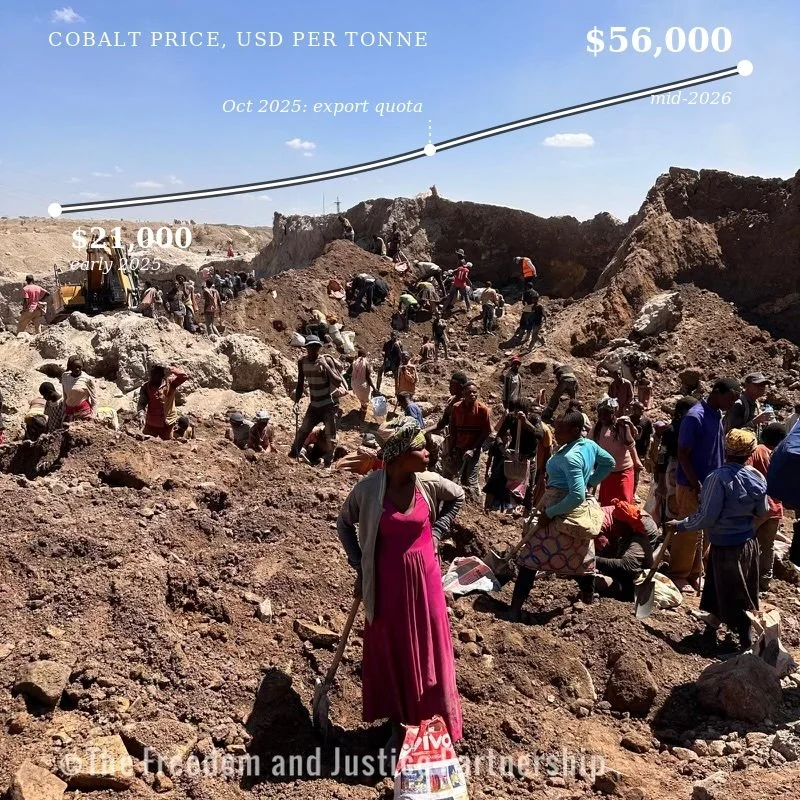
The cobalt price found its floor, the artisanal miners of the DRC have not.
Cobalt has had a spectacular year. A tonne that fetched around twenty-one thousand dollars in early 2025 now trades north of fifty-six thousand. In the language of the market this is a clean story. Prices had slid for years, supply was chaotic, nobody knew what the Congolese state would do from one month to the next. Then Kinshasa capped exports, and the price found its feet. Analysts speak of stability. Traders speak of a floor. The word you hear again and again is control.
We want to suggest that control is precisely the wrong word, and that the floor everyone is celebrating sits under the price and nowhere near those who dig the metal out of the ground.
Start with the mechanism, because the mechanism is where the truth hides. The Democratic Republic of Congo produces the great majority of the world's cobalt. Late in 2025 its regulator replaced an outright export ban with a quota. For 2026, and again for 2027, the country may export no more than 96,600 tonnes, of which 87,000 are shared among the large producers and 9,600 are held back by the state. To put that ceiling in proportion, the DRC dug up something like 204,000 tonnes in 2024. The legal door has been narrowed to less than half its former width.
If you ask yourself who fits through a narrowed door you will realise that it's the orderly and well structured. The large industrial miners, with their lawyers and their logistics, can arrange their affairs around a quota. So can the state cobalt company, EGC, which holds a monopoly over hand-dug supply and was handed an allocation it openly says is nowhere near enough. What the quota cannot reach is the material that never intended to pass through a legal door in the first place. One mining analyst put it this way: the system hurts the transparent producer more than the opaque one, and it makes the black market more valuable. Here is a policy of order that enlarges the disorder around its edges.
And what of the higher cobalt price? It is held high by governmental design and this in turn amounts to an invitation. It tells everyone within reach of a site that the reward for a day in artisanal mines has risen. The legal channels for that extra effort are capped, so the additional metal they lift has nowhere lawful to go. It goes instead into the smuggling routes that sit, by their nature, outside the system anyone is counting. The quota was sold as the state taking hold of its resource. Its likeliest effect is to send more of that resource into the dark.
We have stood at the bottom of one of these places. In the summer of 2024 Carl and I travelled to Kolwezi, no organisation behind us and no security, and walked around the site witnessing unimaginable scenes and dangerous artisanal labour. What strikes you first is the scale of the human effort and the smallness of the tools, sacks and shovels and bare arms set against a hole in the earth that swallows them. The price on a screen in London means one thing in that city and something else entirely to the young man filling a sack below the ground. He sees enough of the number to make the risk feel worth it. He sees almost none of the rest. Between fifty-six thousand dollars a tonne and his afternoon's pay stands a chain of traders and depots and middlemen who take the margin as it climbs. The floor the market celebrates reaches him as a rumour. High enough to draw him in. Never high enough to be fair.
This is what we know as plausible deniability, and we have come to see it less as an excuse than as a structure, and a well-built one. Every link in the chain is arranged so that no link need look too closely at the one beneath it. The refiner buys from a trader, who buys from a depot, who buys from a man he has never met. The quota adds a further and rather elegant layer, because now there is a number, an official ceiling, a paper assurance that the state has matters in hand. The paperwork improves while the pit stays exactly as it was. The metal comes out dirty. The conscience comes out clean.
We have learned that the injustices which endure are rarely the obvious or loud ones. They are the settled arrangements we stop noticing because they have taken on the calm of routine. The vocabulary is administrative and reassuring, and it is doing moral work of a kind that ought to trouble us, because it allows a supply chain to describe itself as orderly while the order rests on a man who appears in none of its figures.
We do not believe the answer is to wish the price back down, or to grow sentimental about the ban that came before. The answer begins with refusing the comfortable word. There is no control here in any sense that should satisfy us. There is a market that has found its floor, and a country whose poorest are being levered further into the shadows by the very policy that claims to be gathering them in. If we are sincere about wanting integrity in our supply chains, and for the products we all use to be free from human rights abuses, we will have to build one that can see all the way to the bottom of the pit, and be willing to look.
The metal in the phone in your hand came from somewhere. The whole architecture is arranged so that you need never ask where. And this is exactly the question we are asking, and will continue to ask.
Freedom and Justice Partnership supports child miners in the DRC to move from dangerous mining activities into education, and educates policy makers and business leaders about human rights abuses in technology supply chains.