
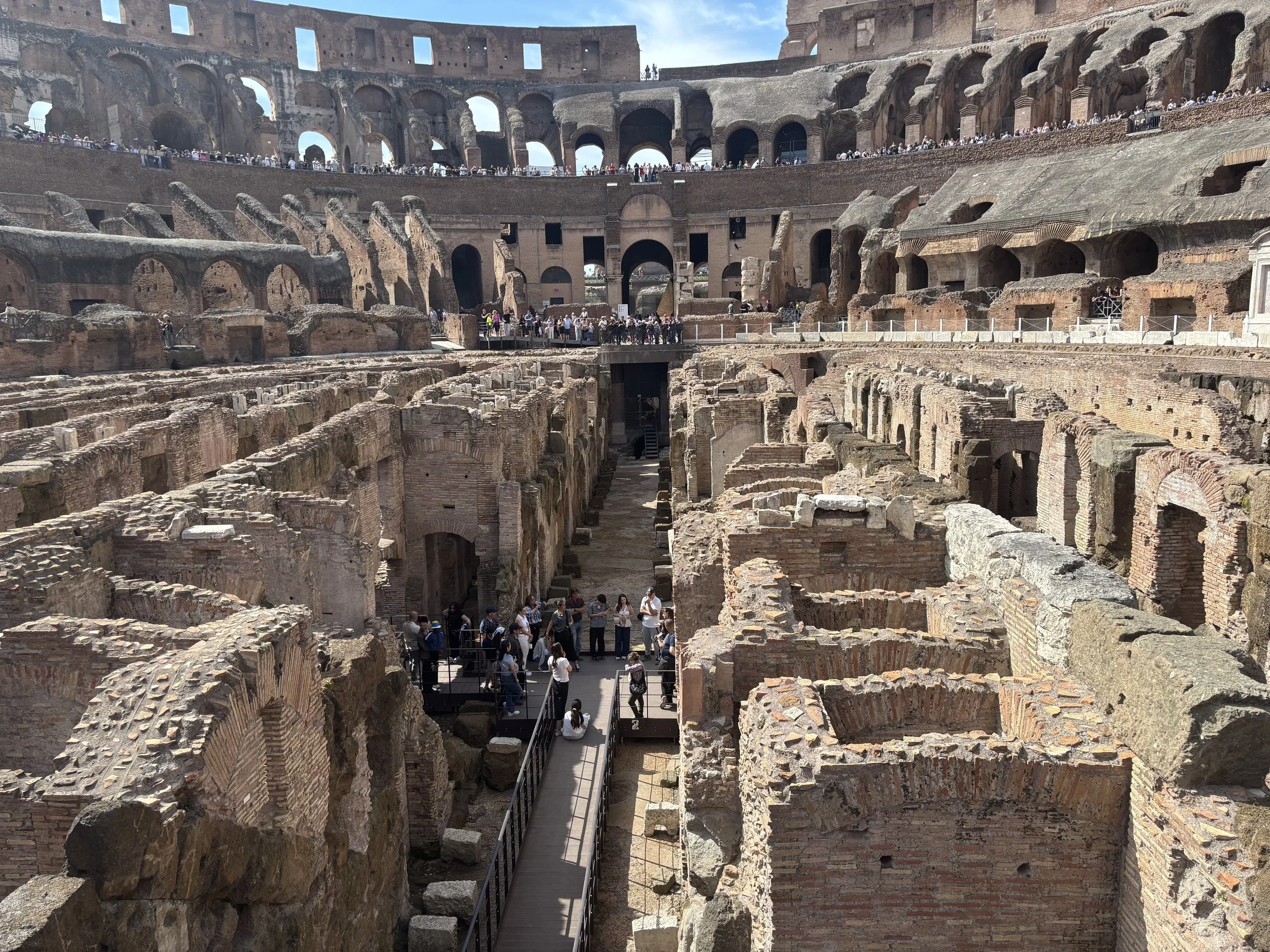
The hypogeum beneath Rome’s magnificent Colosseum.
I stood inside the Colosseum last week with my wife Zoe, shoulder to shoulder with thousands of other visitors, and tried to see it clearly.
It is not easy to see clearly in a place like that. The scale of it pushes you toward awe before you have time to think. The travertine walls rise four storeys into the Roman sky, the arches repeat in their dozens and then their hundreds, and the whole structure curves around you with the confidence of an empire that assumed it would last forever. Nearly fifteen million people visited it last year. They take photographs, they buy guidebooks, they marvel at the engineering. Almost none of them, I suspect, pause to consider who built it.
The Colosseum was funded by plunder and constructed by slaves. After the destruction of Jerusalem in 70 AD, the Emperor Vespasian seized the treasures of the Jewish Temple and marched tens of thousands of Jewish captives back to Rome in chains. The historian Josephus, himself a captive turned Roman client, recorded the aftermath in painful detail: the mass enslavement, the forced marches, the prisoners distributed across the empire for execution or hard labour. A reconstructed inscription found on the site itself confirms the source of the money. Vespasian ordered the amphitheatre to be erected from his share of the spoils of war. The golden menorah and sacred vessels from the Temple were paraded through the streets and displayed in the nearby Temple of Peace. You can still see the relief carved into the Arch of Titus, just yards from the Colosseum, depicting Roman soldiers carrying the looted menorah on their shoulders.
When the building was completed in 80 AD, Vespasian’s son Titus celebrated with a hundred days of games. Thousands of men, many of them Jewish slaves, were killed for the entertainment of the crowd. Over nine thousand animals died alongside them. The arena floor, where tourists now stand and look upward in admiration, was soaked in the blood of the people who had been forced to build the structure around them.
I thought about this as I looked down into the hypogeum, the underground network of tunnels and cells beneath the arena where the condemned waited in darkness for their turn to die. And I thought about a different kind of tunnel, in a different country, on a different continent.
In the summer of 2024, I visited an artisanal cobalt mine in Kolwezi, in the south of the Democratic Republic of Congo. There are no tourists in Kolwezi. There are no guidebooks and no gift shops. There are narrow shafts dug into red earth by hand, barely wide enough for a man to crawl through, descending metres into the ground without ventilation, without structural support, without any of the protections that the word “mine” might imply to a Western ear. Children work in these tunnels. Men die in them regularly. The minerals they extract by hand are sold through a chain of middlemen and refiners until it reaches the battery cathodes of smartphones, laptops, electric vehicles and other devices manufactured by some of the most valuable corporations on earth.
Research conducted by Evidencity, a partner with whom the Freedom and Justice Partnership hopes to work more closely, found that 105 of the 500 companies listed on the S&P 500 create products that can be linked to human rights abuses in the supply chain. Imagine that! More than a fifth of the index that underpins the global economy!
The parallel with Rome is not exact, and I do not want to overstate it. The modern technology industry is not the Roman Empire and obviously no one is saying Tim Cook is Vespasian. But the structural pattern is disturbingly familiar. The most admired institutions of the age, the ones we celebrate for their innovation and their contribution to human progress, are built on a foundation of hidden human suffering that we have collectively agreed not to examine too closely. The Colosseum was a wonder of the ancient world, and it was built by slaves. The smartphone in your pocket is a wonder of the modern world, and the minerals inside it were very likely extracted by people whose working conditions would be recognised by those Jewish captives in first-century Rome.
What strikes me most is not the cruelty itself but the invisibility of it. The Romans did not hide their use of slaves. They paraded them through the streets. They carved images of them onto triumphal arches. The modern version is more subtle. The suffering is outsourced to places most consumers will never visit, processed through supply chains so long and so opaque that responsibility dissolves at every stage. No single company is to blame. No single regulator has jurisdiction. And the consumer, holding the finished product in their hand, has no practical way of knowing what went into it.
This is why the Freedom and Justice Partnership exists. We were founded on the conviction that making supply chains transparent is not a technical problem but a moral one, and that the people at the bottom of those chains deserve to be seen as clearly as the products at the top. Our work in Parliament, our partnerships with data specialists, our advocacy for legislation that holds downstream buyers accountable rather than simply requiring them to disclose their risks: all of it comes back to the same basic proposition. If you profit from a supply chain, you bear responsibility for what happens inside it.
I am glad I went to Rome, I don’t think I have ever been anywhere like it. The Colosseum is remarkable, and there is no contradiction in admiring the engineering while mourning the human cost. But I did leave the eternal city with a question that I think matters more than any architectural detail. Two thousand years from now, when people look back at what we built and how we built it, what will they see? Will they see the innovation? Or will they see the tunnels underneath?