
Different Roads, Same Destination
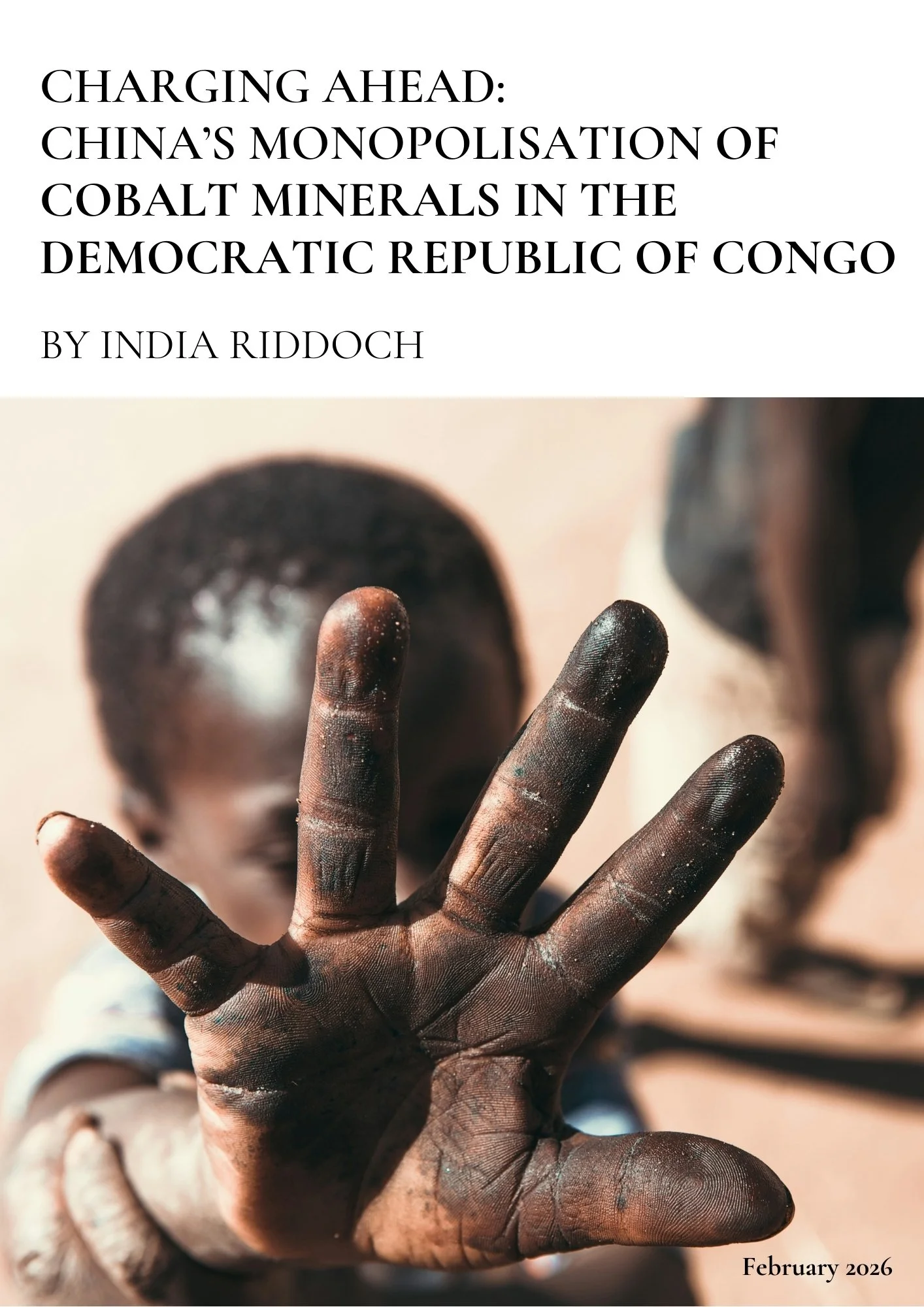
The Cover of India Riddoch’s Report on DRC, China and Key Transition Metals
By India Riddoch and Mark Preston
In the summer of 2024, Mark descended into an artisanal cobalt mine in Kolwezi, in the south of the Democratic Republic of Congo. No permission sought, no safety equipment offered. What he saw there, children working in tunnels barely wide enough for an adult, exposed to toxins with no protection and no recourse, became the founding experience of the Freedom and Justice Partnership.
India arrived at the same place by a different route. Years of academic research at the London School of Economics, hundreds of hours in parliamentary briefings and Hansard archives, a postgraduate thesis on Chinese economic investment in Africa that kept pulling her deeper into a single question: who actually benefits from the cobalt supply chain, and who pays for it?
The answer, in both cases, turned out to be the same.
Charging Ahead: China's Monopolisation of Cobalt Minerals in the Democratic Republic of Congo is India's report, published in February 2026 with the support of the Committee for Freedom in Hong Kong Foundation, and launched at the House of Lords by Lord Lancaster of Kimbolton, UK Government Defence Security Advocate. Mark was invited to speak at the launch and to show footage from inside the mine. It was the first time the two threads had been in the same room together.
It will not be the last. India has asked FJP to host the report, and we are glad to.
The architecture of the problem
The report documents what is, at scale, a story of constructed opacity. The DRC holds around 74% of the world's mined cobalt. China controls approximately 15 of the 19 principal industrial copper-cobalt mining concessions in the country. The 2008 Minerals-for-Infrastructure agreement exchanged minerals valued at roughly $93 billion for $3 billion in promised infrastructure, much of which was never built. The 2024 renegotiation proposed better terms. China has been unreceptive.
In the artisanal sector, which supplies somewhere between 20 and 30% of global cobalt, over 40,000 children were identified working in Lualaba province alone in a 2014 UNICEF survey. Children as young as six. Earning $1 to $2 a day. Squeezed into tunnels that collapse. Handling materials toxic to skin contact. And from those tunnels, the cobalt travels through processing, refining and manufacturing until it arrives, untraceably, in the battery of a phone or an electric vehicle sold in the name of a cleaner world.
The report traces this chain with care. It examines the cross-contamination between legal and illegal mining operations, the water sources around Kolwezi registering toxic metal concentrations above WHO limits, the satellite record of twelve years of deforestation and ecological loss. It interrogates the UK's policy response and finds a government that funds net-zero ambitions with one hand while declining, with the other, to ask where the materials come from.
How the perspectives cross over
There is something worth saying about what happens when an academic framework and a first-hand witness account reach the same conclusions independently. It is not that either validates the other, exactly. It is more that the convergence closes off the usual escape routes.
The figures can be disputed. The footage cannot. The footage can be dismissed as anecdotal. The figures cannot. Together, they are harder to look away from.
That is why this report belongs on the FJP website. Not because FJP produced it, but because the work FJP does, getting children out of those mines and into school, is downstream of the systemic failure India's report maps. Thirty children enrolled so far, funded by public donations. Each one matters. And each one is also a symptom of something that requires a policy response, not just a charitable one.
India's recommendations are specific: a cross-departmental government officer for critical mineral security, mandatory human rights due diligence for UK companies, tariffs on Chinese EV imports, proper annual reporting requirements for companies sourcing from the DRC. These are not aspirational. They are achievable, and they are currently absent.
The report is below. If you work in procurement, policy, technology, finance, or government, it has something direct to say to you. If you don't, it has something to say to you anyway, because the device you're reading this on almost certainly contains cobalt, and almost certainly no one along that supply chain was required to tell you where it came from.
That is the problem India has spent years documenting. It is the problem Mark entered a mine to understand. Different roads to the same dangerous ground.