
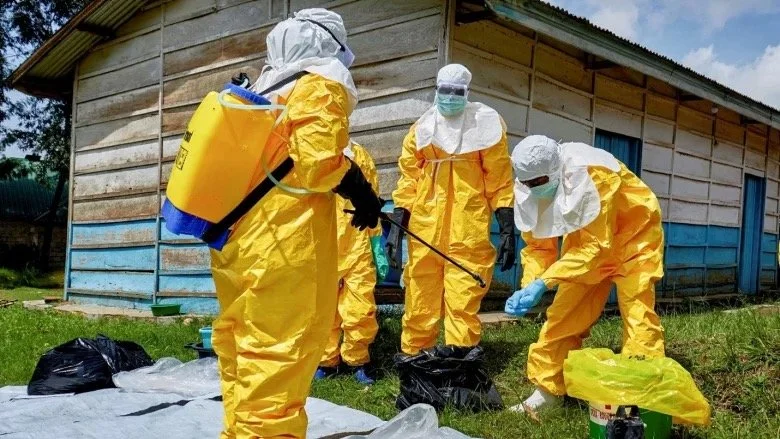
Photo from the World Bank
You may have seen the news. On 17 May the World Health Organisation declared the Ebola outbreak in the Democratic Republic of Congo a public health emergency of international concern. By 25 May the DRC health ministry was reporting more than a thousand confirmed and suspected cases and over two hundred deaths, with cases now crossing borders into Uganda and two suspected cases under investigation in Italy.
A number of you have asked the obvious and caring question. Does this reach the children in Kolwezi?
Here is our understanding of the current situation. The outbreak is in Ituri, in the far northeast of the country. Kolwezi, where the children we support live and where artisanal cobalt mining is concentrated, is roughly fifteen hundred kilometres away in the southern copper belt. There is no direct line from this outbreak to those children. They are not in its path, and the risk of infection reaching them is currently low.
WHY WE ARE TELLING YOU ABOUT IT ANYWAY
This virus represents a serious issue elsewhere in DRC, but it is also emblematic of the risk constantly faced in the mineral-rich nation.
The WHO has been clear that this outbreak is so dangerous because of where it is happening. Ituri is a mining region. It has seen intense conflict over the past two months and more than a hundred thousand people newly displaced.
Health infrastructure is thin. People are moving constantly, in and out of informal mining sites, beyond the reach of any surveillance system. The strain involved, Bundibugyo, has no licensed vaccine and no specific treatment, which means the only things that save lives are early care and a functioning local response.
Read that list again. Informal mining. Displacement. Weak health systems. Constant movement. Children outside any safety net.
That is a description of the conditions artisanal mining children live inside every day, in Kolwezi and across the cobalt belt. This outbreak is a warning about the fragility of the whole system that puts children in the mines in the first place. The children we support are the least protected, the least visible, and the most exposed if anything ever does track along the mining corridors. Though these children are protected today due to the distance, this does not mean they are safe from this outbreak in the future.
WHAT ACTUALLY BUILDS PROTECTION
This is why we keep returning to the same unglamorous things.
A child in school is a child who is not working in a mine, not in a displacement camp, not invisible to the people who could help them. In recent months, your kind support allowed us to make significant grants to the Good Shepherd International Foundation, funding a year of schooling for 90 former child miners in Kolwezi. This is exactly the kind of resilience the children need. It is the difference between a child who is held inside a community and a system, and a child who is exposed to whatever comes next, whether that is a mine collapse, a militia, or a disease.
You cannot vaccinate a community against poverty. But you can keep children in school, keep families connected to services, and keep the most vulnerable people inside a system that can see them and reach them. That is the work. It is slow, it is local, and it is exactly the thing that a crisis like this one shows to be essential rather than optional.
WHAT WE ARE DOING
We are watching the situation closely, in particular any movement toward the mining provinces in the south. We are in contact with partners on the ground. And we are continuing to do the patient work that matters most, which is keeping children in school and out of the mines.
Thank you for standing with us. The reality is that although your support does not make headlines, it does keep children inside the one thing that protects them when everything around them is uncertain.
If you would like to help us reach more children in Kolwezi, you can give via this link